

Women and Islamism
Women and Islamism
14 videos
Watch all the speeches on video.
14 videos
Watch all the speeches on video.
Presentations
Videos from the conference
Read all the papers presented at the conference.






About the conference
This international conference, organised by CERIF with the support of the Auvergne-Rhône-Alpes Region, focused on women and Islamism.
It brought together, in Lyon, researchers, experts, legal professionals, intellectuals and activists who, each from their own field, analysed how women are placed at the heart of the ideological, social and political strategies of contemporary Islamism.
They are sometimes, but not always, mere ‘victims’ of a system; they are also its agents, sometimes its conduits, often its resisters; and it is within this tension that the main contemporary issues are played out: access to rights, bodily integrity, freedom of expression, and the capacity for civic action.
By bringing together these voices from various countries and disciplines, this conference offered a nuanced understanding of the contemporary dynamics of Islamism and their specific effects on and by women, with a view to informing public policy, fuelling research and supporting those who, every day, resist the grip of fundamentalism.
The speakers

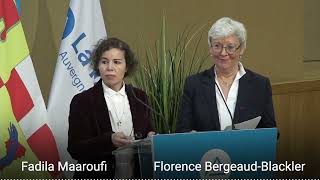
Dr Florence Bergeaud-Blackler
CNRS anthropologist (GSRL-EPHE)
Specialist in halal and Islamic standards. Author of *Le brotherism et ses réseaux* (Seuil, 2023) and *Le Djihad par le Marché* (Odile Jacob, 2025).
"The Brussels Sister Connection"

Fadila Maaroufi
Anthropologist and secular activist
As co-founder and director of the European Observatory on Fundamentalism (Brussels/Paris), she conducts critical research into religious fundamentalism and Islamism.
"The Brussels Sister Connection"

Prof. Fatiha Boudjahlat
Essayist
A history and geography teacher, she advocates a rigorous interpretation of secularism and universalism, opposing religious demands that undermine equality among citizens.
"Women and Islam – agency and marginalisation"

Sonya Zadig
Clinical psychologist, psychoanalyst, linguist and writer
Committed to analysing issues relating to Islam, women’s empowerment and questions of identity.
"The appropriation of the female body and Islamist influence"

Dr Yana Grinshpun
Linguist and academic
A senior lecturer in linguistics at the Sorbonne Nouvelle – Paris III University, she specialises in morphosyntax, historical sociolinguistics and the analysis of media discourse.
"Women, jihad, 7 October"

Lara Fatimi, Solicitor
Criminal lawyer at the Paris Bar
She has been practising at Montbrial & Associés since 2021, specialising in criminal law – particularly the defence of law enforcement officers – and issues relating to secularism.
"The law: a vehicle for infiltration or a bulwark against Islamism?"

Dr Anna Loutfi
Legal expert, researcher and lawyer specialising in human rights
Specialist in Sharia courts.
"The Sharia Question"

Dr Mandana Javan
Journalist and writer
Originally from Iran and now based in Quebec, she specialises in issues relating to the Middle East and women’s rights, particularly within Muslim or community contexts.
"Women in Islamist entryism"

Dr Dalia Ziada
Human rights activist and writer
She is renowned for her work on liberal democracy in the Middle East and has taken a strong public stance on Islamism and women’s rights.
"The Muslim Sisters – From Childbearing to Violent Jihad"

Yasmine Mohammed
Writer and activist
As the founder of the organisation Free Hearts Free Minds, she is dedicated to defending women and those leaving Islam in predominantly Muslim countries, and is a critic of radical Islamism.
"Personal account: from addiction to recovery"
Saturday 13 December 2025, 9am
Programme
Morning
Complimentary coffee
Opening of the conference
A welcome address by Mr Laurent Wauquiez, Auvergne-Rhône-Alpes Region.
The Brussels Sister Connection
Florence Bergeaud-Blackler & Fadila Maaroufi
See the summary
The presentation highlights the exceptional foothold that Islamism has gained in Brussels, particularly through the activism of women’s networks brotherist. It shows that several veiled women involved in politics, community organisations or academia form a ‘Muslim Sisters Connection’, structured around organisations linked to Muslim Brotherhood (LMB, FOIE, FEMYSO, EFOMW, EMN, CCIB…). This network carries out coordinated infiltration of public institutions, NGOs, universities and the media. The same women appear in European initiatives such as the anti-Islamophobia toolkit funded by the European Commission. The thread notes that this network has been active since at least 2014–2015 in campaigns against bans on religious symbols. Taken together, this paints a picture of a coherent strategy of influence, integrated into European and Turkish networks, which shapes the Belgian public debate on the veil and Islamophobia.
Women and Islam – agency and marginalisation
Fatiha Boudjahlat
See the summary
This presentation will examine female agency within Islamic and Islamist contexts, and the way in which religious discourses relegate women to subordinate positions whilst, paradoxically, advocating for their emancipation.
Coffee Break
Complimentary drinks
The appropriation of the female body and Islamist influence
Sonya Zadig
See the summary
The appropriation of the female body under Islamist rule is not merely a mechanism of coercion: it is a comprehensive programme aimed at reducing women to a single function, at severing them from their own presence in the world. The body becomes occupied territory, placed under symbolic seal, stripped of its freedom of movement, desire and visibility. Islamism imposes a grammar of disappearance in which every inch of skin, every gesture, every breath must conform to an external order. This dispossession creates a fragmented subjectivity: a woman summoned to live in retreat from herself, exiled within her own body. What is at stake is not a question of dress or morality, but the methodical destruction of the fundamental right to exist in the open. Emancipation, then, consists not merely in unveiling oneself, but in reclaiming sovereignty over one’s own living space: becoming once more a speaking body, a thinking body, a desiring body.
Women, jihad, 7 October
Yana Grinshpun
See the summary
Traditional sources of Islamic law define jihad as a legitimate war-and, in certain schools of thought, an obligatory one-aimed at extending the political and legal authority of Islam. From this doctrinal perspective, Hamas, the Palestinian branch of Muslim Brotherhood, frames its struggle against the Jews within an eschatological vision that structures the conflict with Israel as a metaphysical struggle between Good and Evil. The events of 7 October, during which Israeli women were killed, taken hostage and, in some cases, subjected to sexual violence, reveal a specific logic: these women were treated as spoils of war, in accordance with representations inherited from historical statuses reserved for non-Muslim women in contexts of conquest. Drawing on strategic documents produced by Hamas leaders, as well as the Dinah report and the report presented to the United Nations by Pramila Patten, we will analyse the sexual violence committed on 7 October in the light of the Islamist ideology underpinning it. This presentation thus aims to link the classical categories of jihad, contemporary theological-political constructs, and the practices observed on the ground.
The law: a vehicle for infiltration or a bulwark against Islamism?
Lara Fatimi
See the summary
The ambivalence of the law towards Islamism: both a tool for infiltration by extremist movements, which know how to exploit legal loopholes with formidable skill, and an essential bulwark for protecting women, guaranteeing their freedoms and defending our republican institutions. This duality calls for constant vigilance: the law can serve the worst as well as the best, provided it is applied with rigour, clear-sightedness and a certain amount of courage.
Lunch break
Resumes at 2.30 pm
Afternoon
The Sharia Question
FR/ENAnna Loutfi
See the summary
The emergence of Muslim communities in the United Kingdom, the rise of parallel legal systems based on Sharia law, the deterioration of women’s personal status, and the weakening of the British democratic state.
Women in Islamist Entrism: Influence, Media Coverage and Discursive Strategies
Mandana Javan
See the summary
This presentation will examine the central role played by certain female figures from Islamist or Islamo-leftist movements in the dissemination and normalisation of demands inspired by political Islamism. Whether community leaders, communicators, activists or academics, they are involved in the gradual infiltration of public institutions, the media, trade unions and university campuses by employing rhetoric that legitimises, normalises or protects the ideology they espouse.
Coffee Break
Complimentary drinks
The Muslim Sisters – From Childbearing to Violent Jihad
FR/ENDalia Ziada
See the summary
The analysis will highlight how these figures become key agents of ideological entryism, by exploiting their public profile, occupying sensitive positions and using the language of human rights to circumvent institutional safeguards. Their actions aim to pit a multiculturalist model against the state’s requirement for neutrality, thereby undermining the fundamental principles of secularism.
Testimonial
FR/ENYasmine Mohammed
See the summary
Yasmine will recount her life story: a childhood in Canada within a family of secular Muslims who later became involved in Islamism, eventually becoming supporters of jihad to the extent that they forced her to marry an Al-Qaeda terrorist. She will explain how the transition from religious observance to Islamist ideology, and then to jihadism, took place.
Round table
Speakers and public figures are working together to consider preventive measures.
Closing
FinRegional Council Building
